
Facts About Prambanan Temple: This Grand Great Masterpiece Is Far More Than Just the Legend of Roro Jonggrang.

Source: Kemenpar
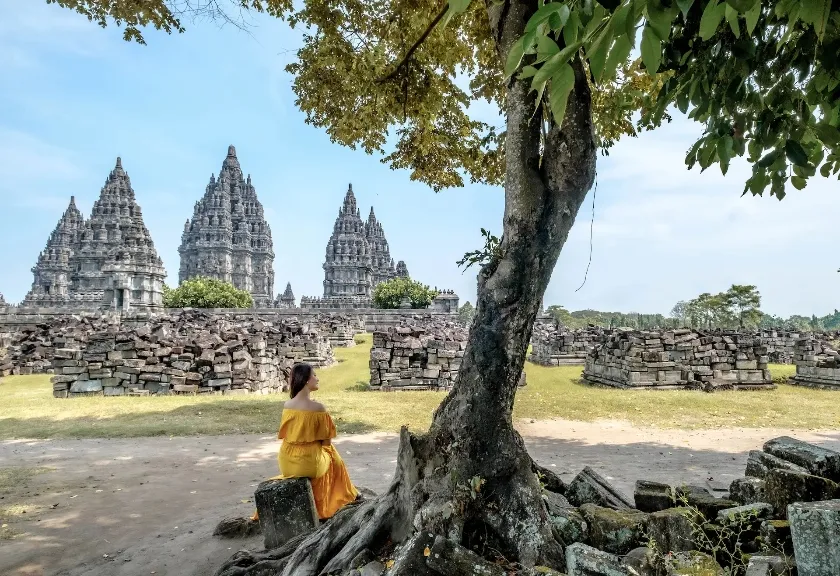
Prambanan Temple stands majestically on the border of Sleman Regency, Special Region of Yogyakarta, and Klaten Regency, Central Java. This largest Hindu temple in Indonesia has long been one of the leading Tourist Destinations that consistently appears on top Visitor Arrival lists.
Prambanan Temple is easily accessible as it sits right along the main Yogyakarta-Solo highway. Unsurprisingly, this site is always crowded with visitors who come to admire its ancient architectural beauty while immersing themselves in the long history of Nusantara civilization.
Yet behind its grandeur, many fascinating facts about Prambanan Temple remain unknown to most people, ranging from its construction origins, the story behind its name, to the legendary folk tale of Roro Jonggrang.
READ ALSO
Exploring Spirituality and Culture at Prambanan Shiva Festival 2026
PM Modi's visit is expected to boost the number of Indian tourist arrivals to Prambanan.
Cirebon Has Major Potential as a Complete Tourist Destination During Eid Holiday
1. Prambanan Temple was constructed in the 9th Century
One of the most widespread misconceptions is the belief that Prambanan Temple was built overnight by Bandung Bondowoso with assistance from supernatural spirits.
In reality, based on the Siwagrha Inscription dated 778 Saka, or 856 AD, construction of this temple was initiated by King Rakai Pikatan, then continued and expanded by King Lokapala and King Balitung Maha Sambu during the rule of the Ancient Medang (Old Mataram) Kingdom.
This means Prambanan Temple is now over 1,100 years old, and stands as one of Indonesia's most valuable historical heritage sites.
2. The original official name of Prambanan Temple is Siwagrha Temple
Prambanan Temple was originally named Siwagrha. This name derives from Sanskrit: Shiva refers to Lord Shiva, while Grha translates to house. Thus, Siwagrha means "House of Shiva".
This naming is confirmed by the large Shiva statue housed inside the main chamber of the central Shiva Temple, which forms the focal point of the entire temple complex.
3. Origin of the name Prambanan
The name Prambanan is widely accepted to originate from the local village where the temple stands. Several historians conclude that the word Prambanan is a Javanese dialect evolution of the term Para Brahman, referring to the Hindu priest community that once settled in large numbers in this area.
4. It does not actually contain one thousand temples
Prambanan is often nicknamed the "Temple of a Thousand" due to the Roro Jonggrang legend. However, archaeological records confirm the total number of structures within the complex never reached one thousand.
Research findings show the Prambanan Temple Complex consists of exactly 240 temple structures: 3 Trimurti Main Temples, 3 Vahana Companion Temples, 2 flank temples, 4 gate temples, 4 boundary marker temples, and 224 smaller perwara shrines.
Meanwhile, the nearby Sewu Temple—whose name literally translates to "one thousand"—also only contains around 249 individual temple structures.
5. The largest Hindu temple complex in Indonesia
Prambanan's grandeur is not only visible in its architecture, but also the scale of its grounds. The main Prambanan Temple Complex covers approximately 39.8 hectares, and is officially recognised as the largest Hindu temple site in Indonesia.
When combined with adjacent protected temple sites including Sewu, Lumbung, and Bubrah Temples, the total heritage area extends to nearly 80 hectares.
This massive scale makes Prambanan one of the largest temple complexes in Southeast Asia, second only to Angkor Wat in Cambodia.
6. Masterful architecture and Ramayana relief carvings
Prambanan's core appeal also lies in its intentional architectural design. The three towering main temples dedicated to Shiva, Brahma and Vishnu are modelled after the sacred Mount Mahameru, the cosmic centre of the universe in Hindu belief.
The entire site layout follows the traditional Mandala concept, divided into three distinct cosmic realms: Bhurloka (the mortal realm), Bwahloka (the spirit realm), and Swahloka (the heavenly realm).
Additionally, the temple walls are decorated with continuous, detailed Ramayana relief panels that depict the epic story of Prince Rama rescuing his wife Sita from the demon king Ravana with the help of Hanuman.
This story remains alive today through the open-air Ramayana Ballet performances held regularly against the lit backdrop of Prambanan Temple, most famously on full moon nights.
7. The folk legend of Roro Jonggrang
Even though it has no verified historical basis, the legend of Roro Jonggrang remains an integral part of Prambanan's cultural appeal.
The tale of Bandung Bondowoso, who was challenged to build one thousand temples in a single night to win Roro Jonggrang's hand in marriage, has been passed down orally for generations and is one of Indonesia's most beloved folk legends.
This folklore gives Prambanan depth beyond its archaeological value, enriching the site with traditional Cultural Heritage of the archipelago.
8. Rediscovery and phased restoration works
After being abandoned for centuries, the overgrown ruins of Prambanan Temple were officially rediscovered in 1733 by Dutch researcher C.A. Lons.
Major systematic restoration works commenced in stages starting in the early 20th century, and have continued under successive Indonesian governments up to the present day.
The restoration process has been extremely challenging: many original stone blocks were lost over time, and international conservation standards require that at least 75% of original building material remains intact for full reconstruction.
Prambanan's exceptional universal value received global recognition when UNESCO inscribed it as an official World Heritage Site in 1991.
This designation applies not only to Prambanan Temple itself, but also the surrounding temple complexes including Sewu, Lumbung and Bubrah Temples.
Conservation of this site still faces ongoing threats, including earthquake risk, volcanic ash fall from Mount Merapi, and damaging behaviour from visitors.
10. Part of the historic Prambanan Plain heritage zone
Prambanan Temple also forms part of the Kewu Plain, also known as the Prambanan Plain, which served as the administrative and religious centre of the Ancient Medang (Old Mataram) Kingdom between the 8th and 10th centuries.
This area contains dozens of important archaeological sites including Sewu Temple, Plaosan Temple, Kalasan Temple, Sambisari Temple, the Ratu Boko Palace Complex, and Ijo Temple.
The concentration of these historic sites confirms that the Prambanan region was once a major political, social and religious centre on the island of Java.
Far more than just a Tourist Destination, Prambanan Temple is a masterpiece of Nusantara civilization that holds extraordinary historical, cultural, architectural and spiritual value.
Source: Indonesian Ministry of Tourism









Belum ada komentar. Jadilah yang pertama!