
Submarine Tourism Without Diving, Indonesia Becomes Target of Chinese Submarine Expansion

Source:
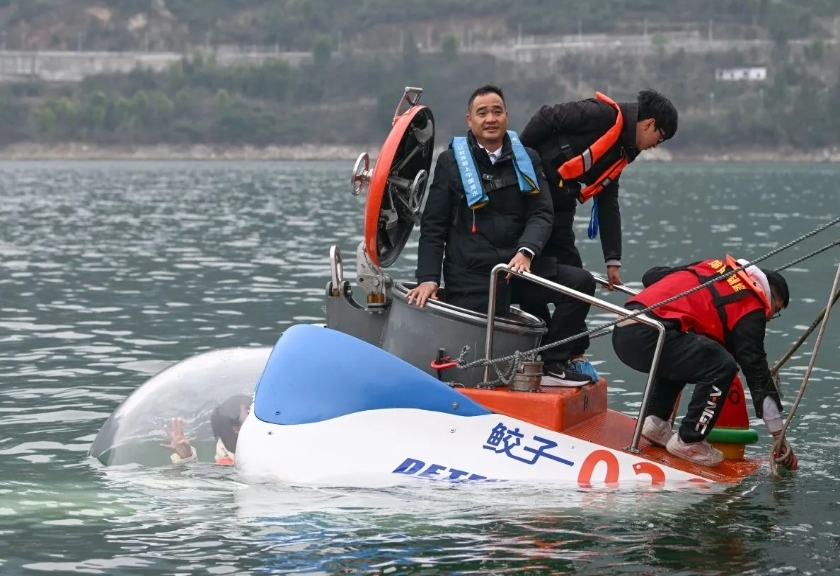
On a tranquil lake surrounded by mountains in Chongqing, Southwest China, the future of Underwater Tourism is being tested. At Shuanglong Lake in Wushan District, the manned civilian Tourist Submarine named Jiaozi has just completed its latest underwater test run.
This test marks a crucial stage before this vessel sails far to the tropical waters of Indonesia, including bali.
This China-independently developed tourist submarine has entered the final stages of acceptance and packaging.
READ ALSO
Sunny weather, Ampenan Beach and Loang Baloq Beach crowded again.
Strengthening Bau-Bau Ferry Services, Connectivity Lifeline to Wakatobi's Marine Paradise
White Sand Situbondo Offers Fishing Spots and Light Festival for Year-End Holidays
After undergoing strict technical verification, Jiaozi will operate in marine Tourism areas like Bali Island, offering a new way to enjoy the underwater world without needing to be a professional diver.
Testing at Shuanglong Lake demonstrated stable performance. In the simulation, Jiaozi smoothly operated at the target depth of 23 meters and then automatically resurfaced according to the preset program.
This trial forms the foundation of confidence before the submarine is deployed in open seas.
Jiaozi was developed and produced by a technology company based in the Wushan District Industrial Park, Chongqing.
Since its establishment in 2018, the company has focused on building an industrial chain for manned civilian submarines, with a vision to promote the use of underwater technology for tourism, science education, and even rescue operations.
Technically, the submarine uses a pure electric system and a pressure-resistant structure designed to withstand depths of up to 200 meters.
The Jiaozi cabin can accommodate four people, equipped with an automatic obstacle avoidance system and a safety buoyancy system.
With this configuration, general tourists can experience the underwater world without requiring special training.
"We designed this submarine with the principle that more and more general tourists can explore the ocean in a safe and controlled environment," said Jiang Zhidi, the company's leader.
Rather than pursuing extreme performance, the development team chose a more grounded path. The primary focus was directed towards system stability, ease of operation, and long-term reliability – three crucial elements for a tourist vessel operating daily.
According to Jiang, the project was enriched by five years of research and development and over 100,000 extreme tests.
Mass production began in January 2024 at the Wushan factory, and to date, more than 30 units have been deployed across various Tourist Destinations in China, including Sanya in Hainan and Weizhou Island in Beihai, Guangxi.
Indonesia is one of the most important targets in this project's international expansion. In October 2025, Jiaozi passed inspections by Indonesia's Ministry of Transportation and obtained operational permits in local tourist waters.
A cooperation agreement was then signed for the phased placement of 100 submarines in tourism areas like Bali, the Thousand Islands in Jakarta, and Lombok Island in West Nusa Tenggara. Currently, three units have begun operational trials in Bali.
"Each country has different characteristics in terms of sea conditions, regulatory systems, and operational methods. Before entering the Indonesian market, we conducted several technical adjustments and verifications according to local requirements," Jiang said.
Furthermore, the company hopes to be sustainably involved in the development of global underwater tourism.
With over 30 research and development personnel, including doctors, and more than 100 independent patents by the end of 2025, this ambition is supported by a strong technological foundation.
At the regional level, officials from the Wushan District Industrial Park Management Committee believe this project promotes the integration of high-end equipment manufacturing with cultural and tourism industries, while accelerating the transformation of the industrial structure towards advanced technology. (Xinhua)





Belum ada komentar. Jadilah yang pertama!