
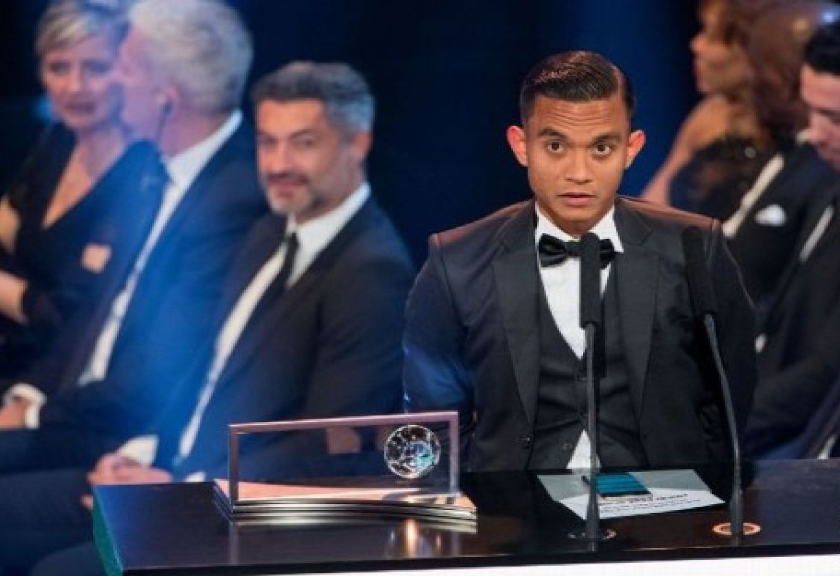
Not Rizky Ridho, but this is the first Asian player nominated for the Puskás Award who won it.

Source: Antara
Rizky Ridho has once again propelled Indonesian football onto the global stage. His long-range goal against Arema FC on March 9, 2025, not only electrified supporters' timelines but has now officially earned him a nomination for the 2025 Puskas Award, FIFA's accolade for the world's best goal, presented since 2009.
This moment makes Ridho the first Indonesian player in history to be nominated for this award, simultaneously positioning him as a pillar in the resurgence of local football under the global spotlight.
Ridho's entry onto the candidate list marks a new chapter for Southeast Asian football. Before him, only one name from this region had ever reached the nomination stage: Mohd Faiz Subri, the Malaysian player who not only was nominated but also won the Puskás Award in 2016.
READ ALSO
2025 Puskas Award Winner Selection No Longer Based on Voting, Can Rizky Ridho Win?
Regarding His Spectacular Goal Entering FIFA Puskas Award 2025, Rizky Ridho's Statement
Rizky Ridho's Spectacular Goal Shortlisted for FIFA Puskas Award 2025 Competing Against Lamine Yamal
Faiz claimed the Puskas Award in 2016, a historical footnote that now serves as the automatic benchmark. Faiz's iconic goal, featuring an extreme swerve in mid-air from a long-range free kick, made him the first Asian player to win the award.
After Faiz, only Son Heung-min followed as the second Asian player to win it, achieving this in 2020. Now, the public wonders again: Can Ridho follow in Faiz's footsteps?
Ridho's goal itself came from an unusual situation. In the Persija Jakarta match against Arema FC at Chandrabaga Stadium, he received a loose ball in his own defensive area. Without hesitation, Ridho unleashed a long-range shot from the midfield area. The ball rocketed powerfully and dipped before finding the net past Lucas Frigeri, who was positioned too far forward.
A goal blending instinct, audacity, and situational awareness – three elements highly valued in the Puskás Award jury's technical assessment.
The moment went viral, but virality alone isn't enough to win this prestigious award. Ridho must compete against top players like Arsenal's Declan Rice and Barcelona's wonderkid, Lamine Yamal.
This competition isn't just about big names; it's about aesthetic quality, match context, and the technical merit of each goal. This is where the intriguing story begins: the Puskas Award isn't decided solely by public voting.
Years ago, this award was known as a competition potentially won by countries with the largest fanbases. If that rule still applied today, Ridho's chances of topping the list would likely be immense.
Indonesian supporters are renowned for being extremely active in sharing, campaigning, and mobilizing digital support. With the massive number of internet users and intense football fandom, the potential "tsunami voting" effect from Indonesian netizens would almost certainly propel Ridho into the favorite position.
However, unfortunately, the winner determination mechanism has changed. Since 2018, FIFA no longer gives full power to the public. Judging is now split equally: half comes from fan votes, and the other half from a panel of FIFA Legends – former players, coaches, and football figures – who will assess based on the technical quality and aesthetic value of the goal.
Ridho can indeed gain significant momentum from the wave of public support, but victory still requires the blessing of the panelists.
This system isn't designed to disadvantage players from big or small nations, but rather to ensure the award doesn't solely depend on click power. Panelists will scrutinize factors like technical difficulty, execution style, impact within the match, and creativity.
In this context, Ridho's goal actually holds considerable merit: he scored it from a defender's position, in open play, from an extraordinary distance – a type of goal relatively rare in professional football.
On the other hand, the comparison with Faiz Subri's goal becomes fascinating. Faiz struck from a free kick, a dead-ball situation allowing for more measured planning and execution. Ridho's goal came from open play, where the decision had to be made in a split second. This aspect of spontaneity and audacity could be a unique selling point for the panelists. The question then is, will it be enough to give Indonesia a new chapter in history?
Ridho himself has appeared very humble in the face of his nomination.
"Alhamdulillah, I am grateful to be nominated for the Puskas Award. Honestly, I never imagined that goal would go this far," said Ridho.
That honesty reflects that for him, this award isn't the target, but a bonus for hard work and consistency on the field. And when a player speaks like that, it only fuels the public's desire to offer full support.
Regardless of who ultimately takes home the trophy, this nomination is already a monumental achievement. It opens up a new conversation about the quality of Indonesian players, the exposure of Liga 1, and the potential of local players at the world level.
Ridho now stands at the crossroads once traversed by Faiz Subri nearly a decade ago, a path proving that Southeast Asian players' dreams are not too distant.
Will Ridho repeat Faiz's history? Or even create a new path for Indonesian football's generation? What's certain is that this nomination is already a small victory for national football. And for the Indonesian public who loves to stand united with their idols.
If public voting were still the sole determining factor, the story might be very different. But under the current rules, the chance depends on how Ridho's goal is interpreted through the eyes of the panelists.
One thing is clear: this story is not finished, and Ridho has already written his important chapter.







Belum ada komentar. Jadilah yang pertama!