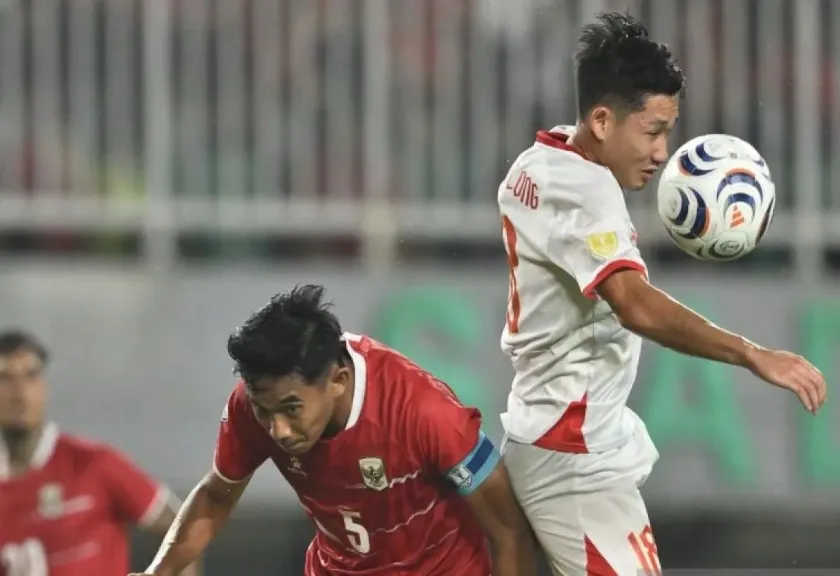

Bogor – The final whistle at Pakansari Stadium, Bogor, did not only mark Vietnam's victory over the Indonesian National Team in the Group A match of the 2026 AFF Cup (ASEAN Hyundai Cup) on Monday (3/8/2026). Behind the 3-0 scoreline lay a full 90-minute tactical battle, one that was never visible amid the roar of tens of thousands of supporters or raw ball possession statistics.
Vietnam did not dominate the match by holding the ball for longer periods. Instead, they controlled space, forced Indonesia to play at their desired tempo, then punished every single mistake with fast, clinical transition play.
This paradox was laid bare by the match statistics.
READ ALSO
Garuda Falls to Vietnam, It Is Time to Rise Up and Chase the 2026 AFF Cup Semi-Finals
John Herdman is impressed by Thom Haye, the versatile all-round midfielder that has Vietnam remaining on high alert.
President Prabowo Sets Sights on the 2030 World Cup, Garuda Challenged to Turn This Great Dream Into Reality
Indonesia recorded 58 percent ball possession, far higher than Vietnam who only held 42 percent of the ball.
But efficiency was the decisive difference. The Garuda squad took 10 total shots with only 3 on target, while Vietnam produced 11 attempts: 6 struck on goal, and 3 resulted in goals.
The fixture at Pakansari served as another harsh reminder that in modern football, ball possession does not equal control of the game.
Vietnam Let Indonesia Play, Then Punished Mistakes
Right from the opening minutes, Vietnam deliberately prioritised maintaining their defensive structure over chasing ball possession dominance. Indonesia was given relative freedom to build attacks from the backline up to the midfield. But the second the ball crossed the centre circle into the final third, Vietnam's defensive block immediately compacted and shut down all operating space.
This approach left Indonesia completely unable to play progressive passes into the forward line.
Thom Haye remained Garuda's main distribution outlet, but his passing lanes were repeatedly cut off, forcing Indonesia to endlessly circulate the ball out wide or backwards into their own half.
As a result, almost all of Indonesia's ball possession took place in non-threatening areas. While Garuda could control tempo during quiet phases, Vietnam successfully controlled every single space that actually decided the match.
Vietnam Waited For Transition Moments
The 6th minute opening goal set the entire tone of the fixture.
Indonesia pushed high up the pitch to win the ball back quickly. But when they lost possession just outside their penalty box, their defensive structure had not fully reset. Nguyen Van Vi pounced on the loose ball to put Vietnam ahead early.
Conceding forced Indonesia to play more aggressively as they chased the deficit. This in turn made Vietnam even more comfortable executing their pre-planned game approach.
The exact same pattern produced the second goal nine minutes later. When Indonesia lost the ball, gaps between their playing lines opened wide, leaving space behind their defensive line completely exposed.
Vietnam moved the ball in just three touches before Nguyen Hai Long finished the attack for their second goal.
In modern football, the moments immediately after losing possession are most often the decisive period of any match. In this fixture, Indonesia's rest defence structure was repeatedly too loose to counter Vietnam's rapid transitions, and the opposition consistently exploited this weakness to create dangerous chances.
Collective Organisation Beat Individual Quality
On paper, Indonesia fielded a high calibre midfield consisting of Thom Haye, Ivar Jenner and Marc Klok. All three circulated the ball well during the initial build up phases.
But Vietnam displayed exceptionally disciplined collective organisation.
They maintained tight, consistent spacing between their lines, meaning the gap between midfield and defence was almost always sealed shut. Every time Indonesia attempted a vertical pass, Vietnamese players would immediately converge to shut down the passing lane.
This forced Indonesia to play almost exclusively horizontal passes rather than attempt to break through the opposition defensive block.
This is the core reason Indonesia's dominant ball possession never translated into high quality goalscoring chances.
Constant Exploitation Of The Half-Spaces
One zone Vietnam repeatedly and deliberately targeted was the half-space: the narrow gap between the centre back and full back.
This vulnerability opened every time Indonesia's full backs pushed forward to support attacks, while the midfield had not recovered to cover the space after a turnover.
Vietnam would then send late runners from the second line, using third man runs to burst into this unmarked gap.
This exact pattern created the third goal. Nguyen Hoang Duc found himself with unchallenged time and space to look up, before playing a through ball to Nguyen Xuan Son.
Vietnam's naturalised striker made a curved run behind Indonesia's defensive line, beat the offside trap, then calmly slotted the ball past Nadeo Argawinata.
Once again, Vietnam did not need long passing sequences to create chances. They chose instead to strike at the exact split second Indonesia's defensive structure had not yet regained balance.
Assessment Ahead Of The Deciding Fixture
At the start of the second half, John Herdman attempted to increase attacking threat by bringing on Jens Raven, Tim Geypens, Beckham Putra and Rizky Eka Pratama.
While Indonesia's attacking intensity did rise, these substitutions failed to solve the core problems: breaking through Vietnam's compact defensive block, and maintaining structural balance when losing possession.
This 0-3 defeat at Pakansari Stadium was not simply an issue of poor finishing. This match demonstrated Vietnam executed a far more mature game plan: controlling space, maintaining defensive organisation, and maximising every chance they created.
Indonesia may have held the ball for longer. But Vietnam proved that at this level of modern football, matches are almost always won by the team that controls space most efficiently, not the team that merely dominates possession.
The Indonesian National Team still retains a path to qualify for the semi-finals. However, victory against Singapore in the final Group A fixture is now mandatory if Garuda are to keep their hopes of progressing to the last four alive.
A full analysis of the tactical battle between Indonesia and Vietnam, along with the critical adjustments John Herdman must implement, is discussed on the ITSMe Podcast. This episode features former Persija head coach and player Isman Jasulmei, alongside football analyst Ronny Pangemanan, hosted by Gilang Respaty and Pudila. The recording took place at ITSMe Studio, Sentul, Bogor.