
Mahashivaratri 2026 at Prambanan Temple: From World Heritage to Global Spiritual Tourism Destination

Source: Antara/HO-IDM
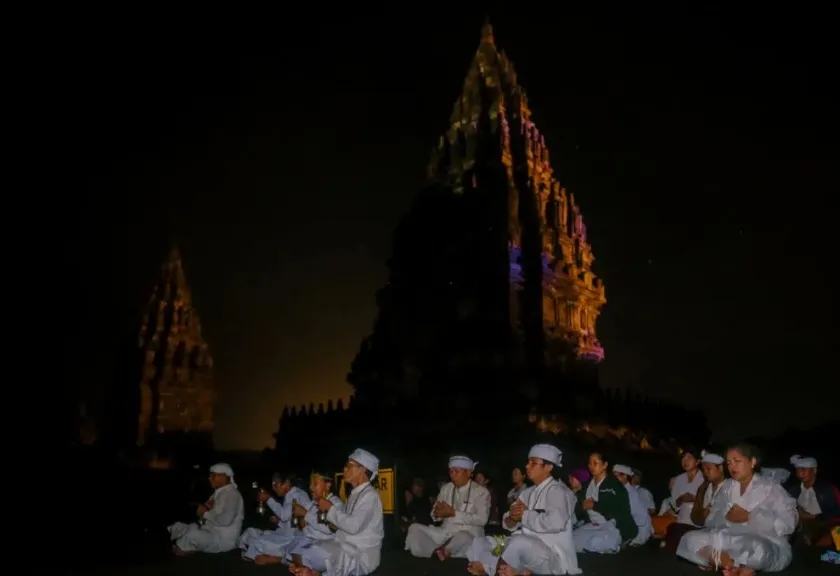
Thousands gathered for Mahashivaratri at the Prambanan Temple complex on Sunday, February 15, 2026. This marked the first time Mahashivaratri was officially celebrated on a large scale in Indonesia at this 9th-century Hindu temple.
Mahashivaratri, or "Shiva's Night," is a Hindu holy day dedicated to Lord Shiva. The celebration falls on the 13th or 14th night of the Magha month in the Hindu calendar, just before Tilem Kepitu.
At Prambanan, this ritual served as the closing event of the Prambanan Shiva Festival 2026 series, which had been Running since mid-January.
READ ALSO
Ramadan Trip: 5 Aesthetic Mosques in West Java for Religious Tourism Spots
2026 Ramadan Tourism Trends: Iftar Hiking to Muslim World's Nocturnal Cities
Chinese New Year Holiday More Exciting! Special Programs at Prambanan and Borobudur
An Open Spiritual Space
The event was collaboratively organized by the Ministry of Tourism, the Ministry of Religious Affairs through its Directorate General of Hindu Community Guidance, the Prambanan Temple Utilization Team under the Ministry of Culture, the Indonesian Hindu Dharma Council (PHDI), and InJourney Destination Management.
Head of the Prambanan Temple Utilization Team, I Nyoman Ariawan Atmaja, stated that holding Mahashivaratri at this complex held special significance because Prambanan is Indonesia's largest Hindu temple complex.
Rituals like Abhisekam, the temple purification ceremony, were performed until dawn, reinforcing the impression that this site is not just a tourist attraction but an active place of worship.
Tourists were also given the opportunity to participate by purchasing a dipa (oil lamp) lighting ticket, which included a nawadatu bracelet. One visitor, Echa, experienced the atmosphere firsthand.
"So, we feel grateful to be here, to feel its energy, to share its energy, at this moment. We are thankful and even express our gratitude for the opportunity to attend such an event," she said.
From World Heritage to Global Spiritual Destination
Since being designated a UNESCO World Heritage Site in 1991, Prambanan Temple has been renowned as a masterpiece of 9th-century Hindu architecture.
However, Mahashivaratri 2026 revealed another potential: the development of spiritual tourism and pilgrimage tourism, which is increasingly relevant globally.
Deputy Minister of Tourism Ni Luh Puspa viewed this festival as part of the national tourism strategy.
"We hope that events like the Prambanan Shiva Festival can enliven Prambanan Temple, not merely as a monument, but as a living monument whose sanctity we collectively preserve," said Ni Luh Puspa.
She added that global Tourism Trends are now moving towards more meaningful and sustainable experiences, where tourists seek connections with local culture and communities.
Data shows the global Hindu population has increased by about 12 percent in the last decade, with 99 percent residing in the Asia-Pacific region.
This figure opens significant opportunities for Prambanan to become one of the Hindu pilgrimage centers in the region.
President Director of InJourney Destination Management, Febrina Intan, called this celebration a crucial step in establishing Prambanan as a living and preserved Cultural Heritage site.
Meanwhile, Indian Ambassador to Indonesia, Sandeep Chakravorty, considered Prambanan one of the best Shiva temples he had ever seen, with great potential to attract tourists from India.
Cultural and National Harmony
The Mahashivaratri series also featured a cultural procession from Kedulan Temple to Prambanan. Holy water from all 36 provinces and nine temples across the archipelago was united in the Maha Gangga Tirta Gamana procession.
During this procession, a nearly one-kilometer-long Red-and-White (Indonesian national flag) flag was unfurled as a symbol of unity.
Chairman of the Central PHDI, Wisnu Bawa Tenaya, emphasized that Mahashivaratri is a moment to build Indonesians both physically and spiritually.
Amid heavy rain in surrounding areas, Prambanan instead became a space illuminated by 1,008 oil lamps. More than just a festival, Mahashivaratri 2026 marked a new chapter: when a historical site is not merely seen, but lived in. (ANTARA)







Belum ada komentar. Jadilah yang pertama!