
Analysis: Indonesia National Team is More Effective, Vietnam Arrives Under Huge Pressure

Source: Asean Hyundai Cup 2026
Bogor - The Indonesian National Team has not yet faced the toughest opponent in Group A of the 2026 AFF Cup. Even so, their first two matches have already given clear signals that John Herdman's squad is developing along the right path.
Garuda did not only secure two wins, they also demonstrated the ability to adapt to the playing characteristics of each opponent.
On the other hand, Vietnam are carrying far heavier pressure after dropping two critical points on their own home ground.
READ ALSO
AFF Cup 2026: When the Garuda is No Longer a Contender
MITCHELL BAKER HATTRICK! Indonesia National Team Shut Out Cambodia 5-1 | AFF Cup 2026
Herdman Names 26 Players for the 2026 AFF Cup, Indonesia National Team Chases Their Maiden Championship Title.
The upcoming match between Indonesia and Vietnam is far more than just a battle for three points. This fixture will act as the benchmark to prove whether the transformation Herdman has constructed can truly elevate Indonesia to the level that Vietnam has dominated for years.
The most striking difference between the two sides is not ball possession capability, but effectiveness once operating inside the final third of the pitch. This is exactly where Indonesia has shown the most promising progress.
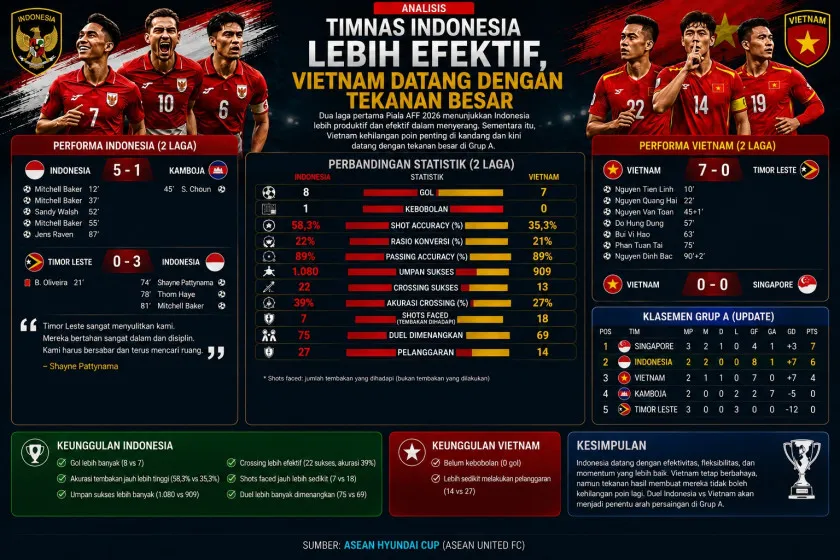
The 5-1 victory over Cambodia stood as the first evidence of this improvement.
When opponents played with an open structure, Indonesia exploited available space exceptionally well.
Mitchell Baker scored a hat-trick, while Sandy Walsh and Jens Raven completed Garuda's goal haul. Rapid attacking transitions, aggressive ball circulation, and clinical finishing were the defining difference.
Yet the real test arrived against Timor Leste. Despite holding a numerical advantage from the 21st minute, Indonesia could not immediately break down the opponent's deep defensive block.
The deadlock was finally broken in the 74th minute via Shayne Pattynama, before Thom Haye and Mitchell Baker sealed the 3-0 victory.
This is where Indonesia's evolution begins to show.
In previous eras, this type of stalemate would regularly cause Garuda to lose all structure and direction in their play. That is no longer the case today.
Indonesia remained patient circulating the ball, maintained their tactical shape, and refused to be drawn into rushed, reckless play.
Once gaps started opening up, they immediately punished the opposition with three goals scored in quick succession.
This means Indonesia no longer relies on a single approach to win matches.
Garuda can perform with explosive intensity against open opponents, while also retaining the patience required to break down compact defences. This tactical flexibility is one of the clearest markers of a maturing national team.
Match statistics only reinforce this observation.

Source: Asean Hyundai Cup 2026
Across two matches, Indonesia have scored eight goals from 21 shots on target, recording a shooting accuracy rate of 58.3%.
Vietnam are only one goal behind with seven total goals, but they only registered 12 shots on target for a shooting accuracy of just 35.3%.
These figures confirm that Indonesia is far more consistent at converting opportunities into genuine threats on the opposition goal.
The two sides are actually very similar in build-up play: both teams hold an identical 89% pass completion rate.
However, Indonesia completed 1,080 successful passes, compared to only 909 recorded by Vietnam.
Garuda's wide play is also far more effective: they completed 22 successful crosses at 39% accuracy, while Vietnam only managed 13 successful crosses with a 27% success rate.
Both defences deserve recognition. Vietnam are yet to concede in two matches, while Indonesia have only been beaten once at the back.
On top of that, Garuda only allowed their opponents seven total shots across two games, and won 75 individual duels - evidence of an increasingly organised defensive structure when out of possession.
That said, statistics cannot be interpreted in absolute terms.
Vietnam remain the defending champions, with proven experience performing in high-stakes matches. They demonstrated their quality with a dominant 7-0 demolition of Timor Leste.
Their goalless draw against Singapore also showed that Vietnam can lose their cutting edge when facing disciplined, well-organised defensive setups.
Current group standings mean all pressure now rests firmly on Vietnam. Singapore lead Group A with seven points from three matches played.
Indonesia sit second with six points from two games, while Vietnam have only collected four points from their opening two fixtures.
This situation means Indonesia still hold full control over their semi-final qualification chances, while Vietnam effectively have no remaining margin for dropped points.
This pressure acts as a double-edged sword. On one hand, Vietnam will likely adopt a far more aggressive approach as they desperately require all three points.
On the other, this approach will open up exactly the type of space that Indonesia exploited so effectively against Cambodia.
For these reasons, this upcoming duel will not just test Indonesia's quality - it will also test whether Vietnam still deserve their status as the benchmark for Southeast Asian football.
For the first time in many years, Indonesia will face Vietnam not as an underdog simply hoping to scrape a single point.
Garuda enter this fixture with convincing underlying statistics, clear tactical progression, and strong rising momentum.
Now all of these advantages only need to be proven out on the pitch.
If Indonesia can maintain the clinical finishing, tactical discipline and tactical flexibility shown in their first two matches, they hold a genuine chance to end Vietnam's long dominance, while sending a clear message that a new era for the Garuda has well and truly begun.








Belum ada komentar. Jadilah yang pertama!