
After holding Spain, Cape Verde is ready to give Uruguay a tough test.

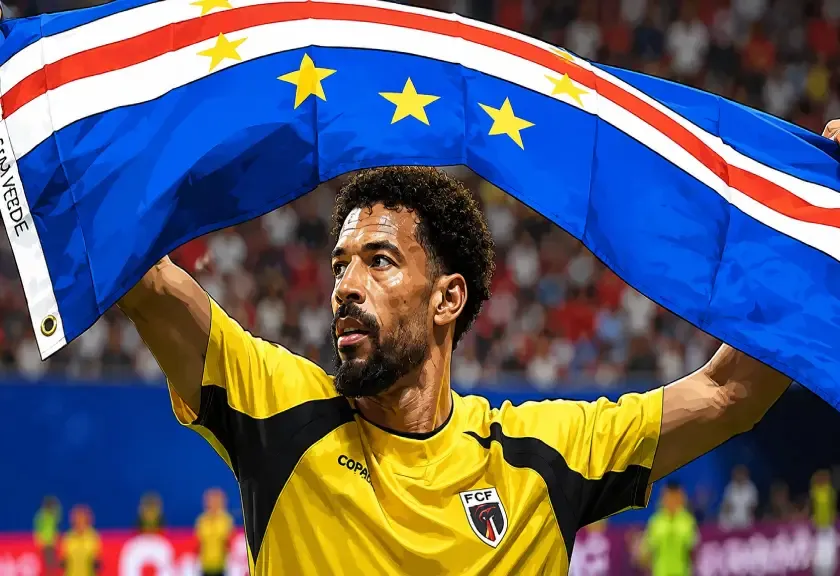
Source: ChatGPT AI
The draw secured by Cape Verde against Spain in their opening 2026 FIFA World Cup Group H fixture was initially framed far more as a failure for La Roja, rather than being recognised as a legitimate achievement for the African representative.
Most criticism focused on Spain's underwhelming performance, with widespread commentary claiming this current La Roja squad ranks among the weakest sides the nation has ever fielded at a World Cup tournament.
Yet when reviewing Cape Verde's competitive trajectory over recent years, this result was never actually a major upset.
READ ALSO
Spain's Resilience Is Challenged By Cape Verde In Their Opening Group H Match
2026 World Cup Effect! Cape Verde has suddenly become a highly sought-after holiday destination for travelers.
Pau Cubarsi wins the 2026 World Cup Best Young Player Award.
The team nicknamed the Blue Sharks are currently living through the greatest golden era in their entire Football history. Their resolute showing against Spain was simply the latest continuation of a long-built positive trend.
Cape Verde's Transformation Into An Emerging Football Power
Following a narrow 0-1 defeat to Mauritania in Africa Cup of Nations qualifiers back in November 2024, Cape Verde has delivered dramatic, consistent improvement.
Across their subsequent 13 matches, they have remained undefeated in regulation 90-minute play. Their only negative outcomes came exclusively via penalty shootouts during friendly matches against Iran and Egypt.
Ahead of the World Cup kickoff, they sent a clear warning signal to all rivals by securing a convincing 3-0 victory over Serbia.
This form confirms that holding Spain to a draw was no lucky fluke. Cape Verde has evolved into a notoriously difficult side to beat, constructed through deliberate, long-term strategic planning.
The football federation of this West African island nation has aggressively scouted and integrated diaspora talent based across Europe, while simultaneously upgrading domestic football infrastructure and forging a clear team identity built on structured organisation and collective teamwork.
This approach mirrors the national economic transformation Cape Verde has achieved over recent decades. The nation successfully transitioned from a low-income economy to one of Africa's most stable democratic and prosperous states, delivered through targeted investment in human capital and the Tourism sector.
More Than Just Physical Strength: Tactical Intelligence
One key factor that sets Cape Verde apart from most smaller underdog nations is the educational background of their playing squad.
International data consistently ranks Cape Verde as having one of the highest literacy rates on the African continent. Many members of their national squad have also attended university or trained at established top-tier European football academies.
As a result, this side does not rely purely on athleticism or raw technical ability: they also demonstrate exceptional tactical awareness and game-reading intelligence.
This was on full display against Spain. Despite being pinned under constant pressure for the full match and facing 27 total attempts on goal, they maintained unbroken focus to secure a clean sheet.
Disciplined defending, consistent concentration and sharp recognition of match momentum are their core weapons, which repeatedly leave opponents struggling to find exploitable gaps.
Uruguay Cannot Risk Underestimating Their Opposition
Cape Verde will next face Uruguay in the second Group H fixture.
On individual player quality, La Celeste remain the clear pre-match favourites. However, their own unconvincing performance against Saudi Arabia exposed clear unresolved flaws within their setup.
Against the Green Falcons, Uruguay only managed a single goal despite registering 27 total shots towards the opposition goal.
This exact scenario risks repeating itself against Cape Verde. Head coach Pedro "Bubista" Leitao Brito has drilled his side to defend with extreme discipline, while remaining patient to launch dangerous counter attacks.
Against Spain, they also recorded an extraordinarily low foul count despite holding barely 25% possession for the entire match: official statistics show Cape Verde committed only one single foul all game, an almost unheard of figure for a side defending sustained pressure.
A Battle Of Patience In Group H
Alongside their rock solid defensive organisation, Cape Verde also benefit from experienced senior figures including Goalkeeper Vozinha, who delivered an outstanding performance against Spain.
Ahead of him, team captain Pico Lopes anchors the backline, maintaining flawless coordination and communication across the defence for the full duration of matches.
That said, Uruguay still hold every chance of taking all three points if they can improve their finishing efficiency in the final third. Marcelo Bielsa is widely expected to have addressed his side's weaknesses after the Saudi Arabia fixture.
Federico Valverde and his teammates will be required to show clinical finishing and calm patience when facing the deep defensive block that Cape Verde will almost certainly deploy once again.
Anything less than a victory will leave Uruguay in a precarious position in Group H, as they are still scheduled to face Spain in their final group match, widely regarded on paper as the strongest side in the group.
For Cape Verde meanwhile, even just one additional point from the Uruguay fixture would put them in a very strong position to preserve their Knockout Stage Qualification Chances. With their form continuing to improve, the Blue Sharks are no longer just tournament makeweights: they are now a genuine threat to every opponent they face at the 2026 World Cup.




Belum ada komentar. Jadilah yang pertama!