
Beyond Tiki-Taka (2): When Data Proves Spain Is More Than Just Champions

Source: ITSME
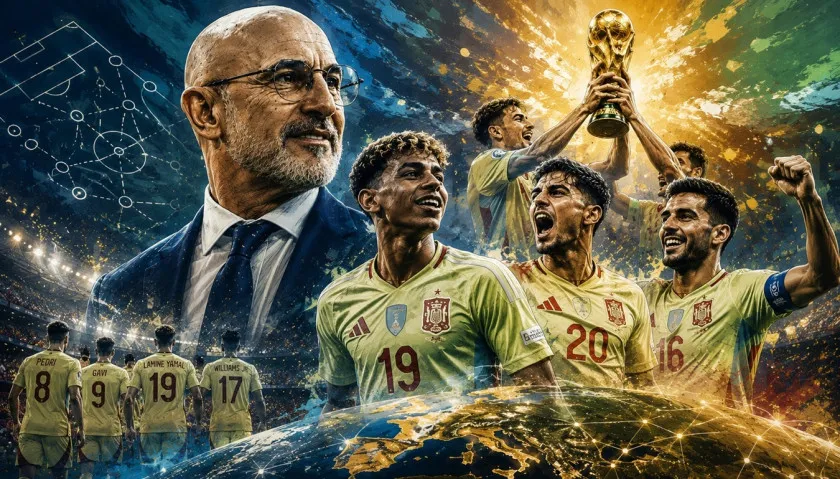
What really happened at the 2026 World Cup Final? The deeper this match is analysed, the clearer it becomes that the 1-0 scoreline tells only the smallest fraction of the real story.
What The Scoreboard Does Not Tell You
Some matches grow simpler with the passing of time.
READ ALSO
Spain Sets a New World Record After Winning the 2026 World Cup
Continued Domination: Spain Remains a Nightmare for France
Spain Becomes France's Nightmare, La Furia Roja Advances to the 2026 World Cup Final
The 2026 World Cup Final was the exact opposite.
The longer this game is studied, the more complex its story unfolds.
On that night at MetLife Stadium, everything looked straightforward. Ferran Torres scored in extra time. Spain beat Argentina 1-0, lifting the World Cup trophy for the second time in their history.
That was that.
That is how history is usually written.
But modern football does not end when the final whistle blows. Behind every match lie thousands of data points, logging every shot, every pass, every pressing action, right down to every off-ball movement made by every player.
When you start reading those numbers, an entirely different story emerges.
Spain registered 20 total shots. Argentina managed just two. According to Opta modelling, Spain created chances worth 2.29 expected goals (xG), while Argentina recorded only 0.22 xG.
The scoreline may have only been separated by one goal.
The dominance was not.
This final turned out to be far more one-sided than the scoreboard ever suggested.
But these numbers only confirm what happened. They do not explain how Spain managed to make Argentina look completely unrecognisable, stripped of their usual identity.
The answer begins with one thing that has so often been misunderstood.
Spain Did Not Control The Ball. They Controlled The Match
For decades, Spanish football has been synonymous with ball possession. In the era of Xavi and Andrés Iniesta, the longer they kept the ball, the higher their chances of victory.
Luis de la Fuente took that philosophy to an entirely new level.
For this 2026 Spain side, the ball was never the end goal. It was merely a tool to control space.
Data shows the vast majority of this match played out inside Argentina's defensive half. Spain consistently worked the ball inside the opponent's final third, forcing Argentina deeper and deeper, pinning them so far back they were completely cut off from the areas where they could build attacking play.
This is the core essence of positional play.
Spain were not chasing possession statistics. They were chasing positions that left their opponent with no good options.
Once they controlled the space, they also had full control over the tempo of the match.
Attacks Begin The Moment They Lose The Ball
Spain's greatest paradox reveals itself the second they give away possession.
For almost every other team, losing the ball is the signal to start defending.
For Spain, that is the signal to start their next attack.
Within fractions of a second, the nearest player closes down the ball carrier. Passing lanes are shut off, space is collapsed, while the rest of the team instantly drops into a structured defensive shield behind them.
This combination of counter-press and rest defence meant Argentina almost never had a single second to build any kind of attack.
Spain did not just win the ball back.
They stole their opponent's time to think.
As a result, Argentina could never establish the rhythm of play that defines their usual style. Every single time they tried to break out of the pressure, they were forced right back to square one.
This is where the match was slowly won.
Not with that single goal.
But through hundreds of tiny, repeated decisions that Spain forced the game to play out exactly on their terms.
When A System Makes Every Player Better
Throughout the tournament, the world talked about Rodri, Pedri, Lamine Yamal, Nico Williams, Pau Cubarsí, and Mikel Oyarzabal.
But the longer Spain played, the harder it became to point to any one individual as the single reason for their success.
Rodri was the balancing anchor. Pedri dictated the tempo. Williams stretched the pitch to open space. Oyarzabal disrupted opposition defensive organisation with intelligent off-ball runs. Cubarsí brought unshakable calm from the back line.
Every one of them performed a different role.
But every single one operated under the exact same collective logic.
This is Spain's greatest strength. They did not build a system that relied on great individual players. They built a system that makes great individual players even greater.
When Data And Observation Arrive At The Same Conclusion
What the data showed was also seen by those who have spent decades studying football's evolution.
Arsène Wenger identified the balance between technical quality, tactical organisation, and collective intelligence as the foundation of Spain's success.
Sid Lowe observed that Luis de la Fuente did not just revive tiki-taka - he evolved it into a far more vertical, aggressive model of play.
Jonathan Wilson pointed to this Spain side as proof that any football philosophy can only survive if it continues to evolve with the times.
Remarkably, all these expert observations align perfectly with the statistical analysis from Opta and The Analyst.
Narrative, data, and analysis all ultimately converge on the same conclusion.
Spain did not just win the World Cup.
They showed the world exactly how modern football is played.
More Than Just A Trophy
The trophy now belongs to Spain.
But perhaps their greatest legacy is not the gold medals, nor the second star above their national federation crest.
Their greatest legacy is an entirely new way to think about football.
For decades, nations built their systems around maximising a single golden generation that came along by chance.
Spain chose a different path.
They built a system that continuously produces new golden generations.
For decades, the greatness of a football nation was measured solely by how many trophies they had won.
The 2026 World Cup may have offered a new measuring stick.
Greatness is no longer about having the single best player. It is about having the system that keeps producing the best players, over and over again.
If this becomes the direction global football takes after that night in New Jersey, then Spain's greatest legacy will not be this World Cup trophy. It will be that they redefined what it actually means for a nation to be great at football.




Belum ada komentar. Jadilah yang pertama!