
Brazil vs Japan: When the Pupil Challenges the Master on the World's Greatest Football Stage.

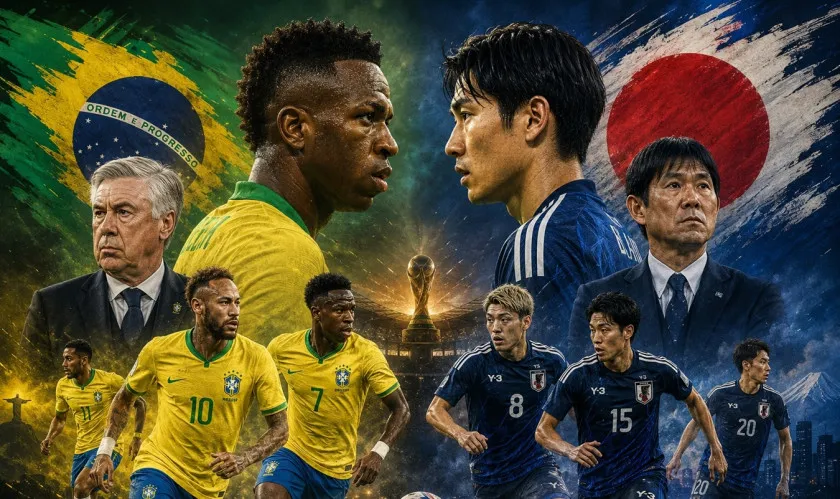
Source: ITSMe - ChatGPT AI
On paper, Brazil remain the clear favourites. Five-time world champions, boasting players who shine at Europe's elite clubs, and now led by Carlo Ancelotti, one of the most successful coaches in football history. Yet their Round of 32 clash against Japan at the 2026 World Cup, hosted at Houston Stadium on Monday (29/6) evening local time / early Tuesday (30/6) WIB, carries far greater weight than just a battle for a spot in the next knockout round.
This is the moment the student challenges their teacher.
For over three decades, Japan built the foundations of its football programme by learning extensively from Brazil. Ever since the J.League launched in 1993, the arrival of Brazilian players and coaches accelerated the development of professional football in the Land of the Rising Sun. Legends including Zico and Dunga became defining symbols of this bilateral relationship, while Brazil's distinctive playing philosophy left a lasting mark on the evolution of Japanese football.
READ ALSO
Positive Momentum as Japan's Advantage Ahead of Facing Brazil in the 2026 World Cup Round of 32
Zico has warned Brazil that Japan could pose a serious threat in the Round of 32 stage of the 2026 FIFA World Cup.
Many Paths to the 2026 World Cup Round of 32: Who Will Qualify, Who Will Stumble?
That relationship has now entered a new chapter. Japan no longer comes only to learn. The Blue Samurai take this field with conviction that they can compete on equal footing with the nation that has long been one of their greatest inspirations. Marcus Tulio Tanaka, the Brazil-born former Japan international defender, went as far as to describe this as the long-awaited moment: the first time Japan stand against Brazil as truly evenly matched opponents.
This confidence is the product of a consistently executed long-term project. In 1992, ahead of the J.League launch, Japan unveiled its '100 Year Vision' - an ambitious roadmap to embed a national football culture and ultimately become world champions.
As Japanese football progressed rapidly, the Japan Football Association (JFA) formalised this target for 2050 via an official national football development declaration and masterplan. This blueprint prioritises youth academy development, raising domestic competition standards, integration of sports science, and supporting more Japanese players to build careers at Europe's elite leagues.
But Hajime Moriyasu's squad have no intention of waiting until 2050. Midfielder Daichi Kamada has publicly stated the group's target is to win the 2026 World Cup. This mindset makes it clear: Japan no longer consider themselves simply tournament participants. They now see themselves as genuine title contenders.
Ironically, the very first obstacle standing between them and that dream is Brazil.
The Seleção arrive with equally huge ambition. Brazil have not lifted the World Cup trophy since 2002, and have spent decades searching for the formula to return to global dominance. To end this 24-year wait, they broke a long-held national tradition by appointing Carlo Ancelotti as their first foreign head coach. Under the Italian tactician, Brazil have retained their trademark attacking identity while adding far greater tactical flexibility.
Vinícius Júnior is the face of this revival. The Real Madrid forward finished the group stage with four goals, and operates as the creative heartbeat of Brazil's attack. Neymar, who has been steadily building back match fitness, is also expected to take on an increased role for this fixture.
This Houston fixture also carries the weight of revenge. Last October, Japan secured a historic 3-2 friendly win over the senior Brazilian national team - their first ever victory against the Seleção after 14 previous meetings. That defeat served as an early wake-up call for Ancelotti as he rebuilt this Brazil side, and this World Cup knockout tie now presents the opportunity to settle the score.
While Brazil still hold the edge on individual player quality, the Blue Samurai have proven repeatedly in recent years that they can match and even beat elite football nations. Rigorous tactical discipline, rapid transition play, and fierce collective unity are the hallmarks that set Japan apart from most other Asian sides. Moriyasu has also specifically prepared his squad for the possibility of a penalty shootout - a hard lesson learned from their painful 2022 World Cup exit.
At its core, this Brazil vs Japan fixture is far more than just two teams fighting to stay in the tournament. It is a collision between two competing philosophies of football development. Brazil are built on unbroken tradition, natural raw talent, and the legacy of past world titles. Japan have taken the opposite path: methodical sustained development, sports science, and decades of deliberate long-term planning.
Whoever emerges victorious will not only advance further in the 2026 World Cup. They will also earn vindication that the path they have chosen to reach the summit of world football is the right one. For Japan, a win would mark the ultimate coming of age: proof that the student has finally stood toe to toe with, and outgrown, their teacher on football's greatest global stage.

Belum ada komentar. Jadilah yang pertama!