
TACTICAL ROOM: When the Semi-Final Almost Belonged to England — Then Messi Changed Everything

Source: ITSMe
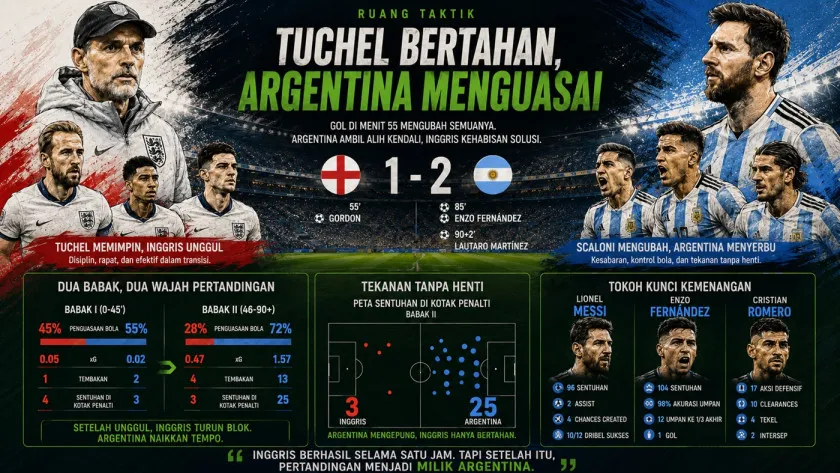
The final score shows Argentina beat England 2-1. But that number does not tell the full story of how this 2026 World Cup semifinal shifted direction.
What turned this match was not just the two goals scored in the final eight minutes.
The real turning point came far earlier—when England chose to drop deep and defend after taking a 1-0 lead in the 55th minute.
READ ALSO
After 20 years of his career, Messi finally faces England on the World Cup stage.
Scaloni Focuses on the Pitch, Does Not Want Argentina vs England to Be Overshadowed by Past Conflicts
England Admit They Were Lucky to Eliminate Norway, Tuchel: We Must Play Better in the Semi-Finals
From that moment onwards, the game slowly drifted completely into Argentina's control.
This was not because Lionel Messi suddenly pulled off a miracle.
Nor was it because England suddenly collapsed into poor play.
This happened because Lionel Scaloni seized control of space, tempo and flow of the match, while Thomas Tuchel lost every way to keep his side a threatening force.
At its core, this semifinal was two entirely separate matches wrapped into one.

Source: ITSMe
It is the half-by-half match statistics that properly explain how this game unfolded. The overall match figures (64% Argentina possession) actually mask the dramatic shift that occurred after the 55th minute.
First Half: Tuchel Controlled Space, Scaloni Controlled The Ball
One of the most common mistakes when analysing this match is only looking at full-time possession statistics.
Yes, Argentina had more of the ball.
But at half time, that possession had not translated into any actual attacking dominance.
Argentina held 55% of the ball, but recorded just 0.02 expected goals.
England by contrast, despite only having 45% possession, posted a higher xG figure of 0.05.
The difference came down to space.
Thomas Tuchel had set up an extremely disciplined defensive block.
Central corridors were completely shut down.
Distances between defensive lines remained tight.
Messi was forced to drop very deep repeatedly just to receive possession.
Julián Álvarez could find no space to run in behind the defensive line.
Argentina had the ball.
But England owned the space.
In modern football, controlling space is almost always more decisive than simply controlling the ball. For the opening hour of this match, Tuchel's game plan was working almost perfectly.
55th Minute: Gordon's Goal That Turned The Match On Its Head
Anthony Gordon broke the deadlock with a sharp counter attack finish.
That goal looked like total vindication for every part of England's game plan.
Ironically, it would become the match's turning point.
Psychologically, both sides entered an entirely new phase.
England began thinking only about protecting their lead.
Argentina no longer had any reason to play patiently.
Tuchel responded by dropping his entire defensive line deeper.
High pressing was abandoned.
Priorities shifted completely from hunting a second goal to protecting the scoreline.
On paper this was a logical decision.
Nearly every elite manager will take this approach when leading in a knockout match.
But against this Argentina side, this choice carried massive consequences.
Handing possession over to Messi means handing over complete control of the match tempo.
And that was the moment Argentina began to take over this semifinal.
Second Half: Argentina Seizes The Tempo
The statistical shift in the second half was stark.
Argentina:
72% possession
13 shots
25 touches inside the penalty area
1.57 expected goals
314 completed passes (93% accuracy)
England:
28% possession
4 shots
3 touches inside the penalty area
0.47 expected goals
95 completed passes (75% accuracy)
This is where the match truly changed.
Most observers point to possession as the cause.
But possession was only the result.
The real root cause was that England could no longer hold onto the ball for any meaningful period after winning it back.
Nearly every spell of England possession lasted just seconds before the ball was returned to Argentina.
The result was unrelenting, unbroken pressure.
Every minute England spent defending pushed their defensive block deeper and deeper towards their own goal.
The deeper that block retreated, the less possible any counter attack became.
A self-reinforcing cycle formed that played entirely into Argentina's hands:
win back possession → circulate the ball → surround the penalty area → briefly lose possession → win the ball back immediately.
This cycle repeated almost non-stop for the entire second half.
Tuchel Was Not Wrong To Defend. England Was Wrong To Stop Threatening.
This is the detail that is almost always oversimplified.
England's mistake was not playing defensively.
Their mistake was that they stopped being a threat.
A low block is not a bad strategy.
It has been used to win European Championships and World Cups.
But a low block only works if two conditions are met.
First: the defensive structure remains organised and tight.
Second: the opposition remains scared of your counter attack.
That second condition slowly vanished.
The critical moment came in the 72nd minute.
Anthony Gordon was substituted off.
Ezri Konsa was brought on to add extra defensive cover.
But in doing so, England removed their only fast player capable of running in behind Argentina's defensive line.
Once the counter attack threat was gone, Argentina could push their entire line forward without fear.
Their defenders pushed higher up the pitch.
Midfielders advanced right up to the edge of England's penalty area.
There was no longer any downside to losing possession.
From that point onwards, almost the entire match was played inside England's final third.
Messi Did Not Score. But He Controlled Everything.
This semifinal will not be remembered for spectacular Lionel Messi goals.
But tactically, this was one of his most masterful performances.
Messi Match Stats:
- 96 touches
- 2 assists
- 4 chances created
- 6 passes into the final third
- 10 successful dribbles from 12 attempts (83%)
- FotMob Rating: 9.0
Messi was not the player covering the most ground.
He was the player deciding exactly where this match would go.
Sometimes he slowed everything down.
Sometimes he burst the tempo open.
Sometimes he just shifted the ball a few yards sideways.
But almost every single decision he made edged Argentina closer to England's goal.
His two assists were not luck.
They were the end product of the tempo control he had built over the entire second half.
Enzo Fernández: Argentina's Metronome
If Messi was the final brain of the attack, Enzo Fernández was the central distribution hub for the entire side.
His statistics tell the full story:
- 104 touches
- 82 completed passes from 84 attempts (98%)
- 12 passes into the final third
- Scored the equalising goal
Nearly every single Argentina forward progression went through Enzo.
He kept the ball circulation alive.
He made sure the tempo never dropped.
His 85th minute equaliser changed the scoreline.
But his biggest impact had already been felt long before the ball crossed past Jordan Pickford.
Cristian Romero Shut Down England's Escape Route
Argentina's dominance was not built only by their attacking players.
Cristian Romero was the foundation that destroyed every England attempt to break out of the pressure.
His match figures:
- 17 defensive actions
- 10 clearances
- 4 tackles
- 2 interceptions
- 1 block
Every single time England tried to launch a counter attack, Romero was almost always the player that snuffed it out.
This is what allowed Argentina's unbroken cycle of pressure to continue.
Substitutions That Shifted The Match Dynamics
Lionel Scaloni read the shifting match perfectly.
In the 64th minute he brought on Nicolás González.
Eight minutes later Rodrigo De Paul, Gonzalo Montiel and Nicolás Otamendi were also introduced.
These were not just fresh leg substitutions.
They were made specifically to maintain pressing intensity, ball circulation quality and attacking momentum.
By contrast, every one of Tuchel's substitutions was focused only on protecting the lead.
When Gordon left the pitch, England lost their single biggest counter attack threat.
From that moment Argentina could commit ever more players forward without hesitation.
Why Did England's Low Block Finally Collapse?
The answer is very simple.
It was not because England's defensive organisation was bad.
It was because the pressure lasted too long.
Second half data shows:
- 25 Argentina touches inside the penalty area
- 13 total shots
- 3 big chances created
- 1.57 xG
In modern football there is almost no team on earth that can withstand constant, sustained pressure of this volume.
Enzo Fernández's 85th minute goal was not the start of Argentina's comeback.
It was just the first crack finally opening after half an hour of unrelenting pressure.
Lautaro Martínez's 90+2 minute winner was the entirely logical consequence of that dominance.
Final Thoughts
This semifinal was not a story of Argentina being the better side from the first whistle.
Instead this match split cleanly into two completely distinct phases.
For the opening hour, Thomas Tuchel had successfully forced Argentina to play a game they did not want. England shut down space, neutralised Messi's creativity, and took the lead with clinical counter attacking football.
But once they went ahead, that balance shattered. The choice to drop deep and defend cost England all control of the match tempo, and completely removed their counter attack threat.
Argentina exploited this situation with remarkable patience. Through Enzo Fernández's distribution, Lionel Messi's game management and constant pressure high up the pitch, they slowly seized control of every single aspect of the match.
The final statistics will show Argentina had 64% possession and won 2-1. But the numbers that actually define this semifinal all come from the second half: 72% possession, 13 shots, 25 penalty area touches, 314 completed passes at 93% accuracy, and 1.57 expected goals.
This semifinal was not won by one magical moment or one single bad decision.
It was won by the side that could best control space, tempo and momentum when the match entered its most decisive phase.
Lautaro Martínez's stoppage time winner was just the final full stop on a process that Argentina had been building ever since the 55th minute—the moment control of this match slowly slipped from Thomas Tuchel's hands, and into the hands of Lionel Scaloni and Lionel Messi.








Belum ada komentar. Jadilah yang pertama!