
Sentul, Bogor - For almost 85 minutes, this 2026 World Cup semi-final appeared to be unfolding exactly as Thomas Tuchel had planned. England played with tight discipline, held a 1-0 lead through Anthony Gordon, and were just minutes away from booking their place in the final.
Yet modern football is rarely decided by who holds a lead the longest. Instead, matches are won by the side that can maintain composure and control when pressure reaches its absolute peak.
On the pitch in Atlanta, Argentina demonstrated exactly why they remain one of the most tactically mature national teams in world football.
READ ALSO
England vs Argentina: Who Will Reach the 2026 World Cup Final? Analysis by Ronny Pangemanan & Kesit
England are slightly favoured, but Argentina hold a perfect semi-final record at the World Cup.
England Failed to Reach the 2026 World Cup Final, Tuchel's Strategy Changes Have Come Under Criticism
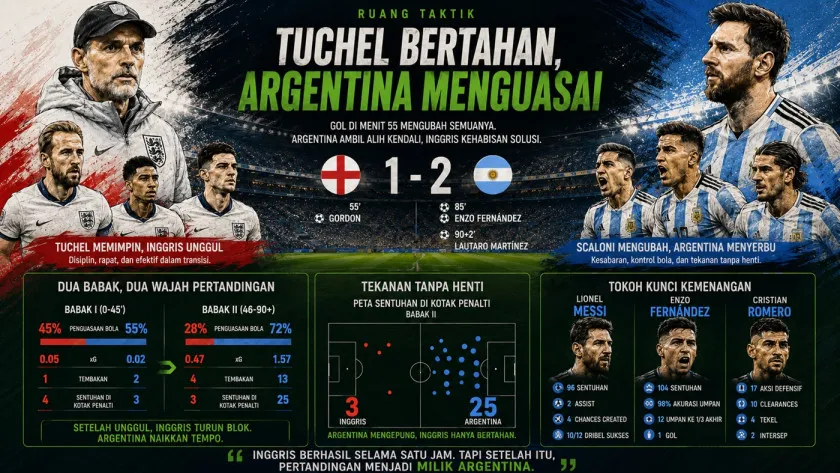
This fixture split cleanly into two starkly different phases. In the first half, England successfully neutralised space despite ceding possession. Argentina recorded 55% ball control, but only generated an expected goals (xG) value of 0.02, while England posted 0.05 xG over the same period.
Lionel Messi was forced to drop deep just to receive the ball, while Julián Álvarez and Lautaro Martínez could not find any operating room in the final third.
The turning point arrived directly after Anthony Gordon scored in the 55th minute. Rather than maintaining transition threat, England elected to drop into an ultra-deep defensive block to protect their advantage. This choice slowly shifted the entire momentum of the match.
For the remainder of the second half, Argentina took complete command. They finished the half with 72% possession, 13 total shots, 25 touches inside the opposition penalty area, and 1.57 xG. By contrast, England managed only 28% ball control, four attempts on goal, and just three touches inside Argentina's penalty box.
England's failure was not simply choosing to defend. They lost all ability to retain possession and ceased to pose any attacking threat entirely. Almost every time they won the ball back, they surrendered it again within seconds. Relentless mounting pressure pushed England's entire defensive line further and further back towards their own goal.
This was where Lionel Messi exerted his defining influence. Though he did not score himself, the Argentine captain dictated the full rhythm of the match, finishing with 96 touches, two assists, four chances created, and 10 successful dribbles. Behind him, Enzo Fernández anchored Argentina's circulation with 104 touches, 98% pass accuracy, and the equalising goal that broke England's resistance.
Argentina completed the comeback with Enzo Fernández's 85th minute strike, followed by Lautaro Martínez's stoppage time winner. This decisive goal was no random moment of magic - it was the inevitable peak of consistent, sustained pressure that had built ever since England surrendered control of the game.
This semi-final proved that a low block defensive system is not an inherently flawed strategy. But without a persistent counter-attacking threat to force the opposition to remain cautious, a deep defence will only be crushed under growing waves of pressure. That is exactly what unfolded for England, and Argentina exploited this weakness perfectly.
Full breakdown of the tactical shifts, Thomas Tuchel's game management decisions, Lionel Messi's quiet match control, and all factors behind Argentina's comeback will be discussed on the ITSMe Podcast, featuring football analysts Ronny Pangemanan and Erwin Fitriansyah.
Hosted by Gilang Respaty and Yatna from ITSMe Studio, Sentul, Bogor, this episode examines exactly why the match completely transformed after the 55th minute, and the core tactical lessons that can be taken from this historic 2026 World Cup semi-final.