
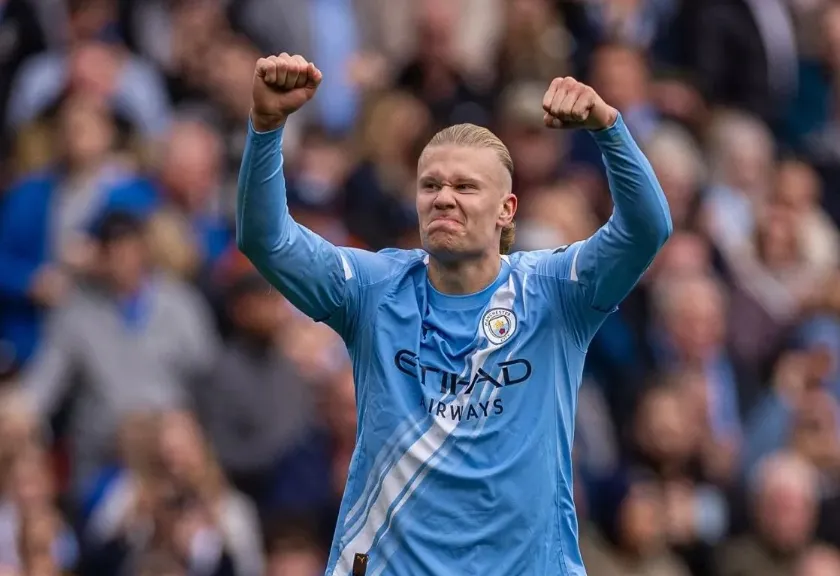
The Erling Haaland phenomenon is shaking the world, ranging from his unique nicknames all the way to the trend of his name being chosen as a given name for newborn babies.

Source: Antara Foto/Xinhua
Erling Haaland has not only captured attention for his clinical sharpness on the pitch, but also for the cultural influence he has spread across all corners of the world. After leading Norway to qualify for the 2026 World Cup for the first time in 28 years, the Manchester City striker's global renown has grown even further, transcending the boundaries of football entirely.
In China, Haaland's popularity does not stem solely from his goals. It is also driven by his facial expressions, mannerisms, and distinct personality.
This widespread appeal earned Haaland a special local nickname in China: Habal, or "Ha-Baby". The moniker captures the contrast between his fierce, unyielding demeanor during matches, and the endearing public persona that has won over online audiences.
READ ALSO
As Norway advances to the 2026 World Cup quarter-finals, Haaland stated: One chance is already enough!
Norway vs England: Three Lions Are More Fancied to Reach the 2026 World Cup Semi-Finals
2026 World Cup: This is the reason Norway moved hotels, and it is not due to a disease outbreak.
This cultural phenomenon accelerated when Haaland launched official accounts on China's major domestic social media platforms, Douyin and Weibo. Both accounts amassed millions of followers within an extremely short period.
His presence on local social media opened up commercial partnership opportunities. Haaland subsequently featured in an advertising campaign for Chinese herbal drink brand Walovi. His effort to deliver his lines in Mandarin for the advertisement was warmly received, and boosted his popularity even further.
Today, Haaland's face appears not just in sports news coverage, but also across digital stickers, internet memes, and recommended short video feeds throughout China's online spaces.
This trend demonstrates that the appeal of modern athletes is no longer defined solely by trophy counts or goal tallies. Authentic personality and genuine connection with fans are now equally critical factors in building a global public profile.
Haaland has even publicly stated that he likes the "Habal" nickname given to him by his Chinese supporters. It has now become a distinct, widely recognised identity attached to him within the country.
Haaland's cultural reach extends as far as Peru, where public fascination with the striker has manifested in deeply personal ways.
According to data from Peru's national civil registry authority, over 500 parents across the country have named their newborn baby boys Erling Haaland. This trend stands as clear proof of the enormous off-pitch influence the 26-year-old footballer commands.
For many families in Peru, choosing the name Erling Haaland is not merely following a passing trend. They view the name as a representation of unyielding resilience, physical fortitude, and the consistent success Haaland has demonstrated throughout his professional career.
Naming children after famous footballers is by no means a new phenomenon. In previous years, names such as Lionel Messi and Cristiano Ronaldo were also widely adopted by parents across the world. However, the sudden, sharp surge in babies being named Haaland highlights the extraordinary strength of his personal brand.
The Haaland phenomenon confirms that football has evolved to become an integrated part of global culture. From the "Habal" nickname in China to newborn names in Peru, Erling Haaland's influence has long crossed the boundaries of sport, cementing his status as one of the most iconic figures in modern football.


![Arsip foto - Konser realitas virtual grup K-pop BTS]](https://cdn.itsme.co.id/library/2/7/0/2/arsip-foto-konser-realitas-virtual-grup-k-pop-bts_840x576.webp)
Belum ada komentar. Jadilah yang pertama!